Ars Technica Food Court
2001 - 2005
Ars Technica covers the news and opinions in technology, science, politics, and society, created by Ken Fisher and Jon Stokes in 1998. The Ars Technica Food Court was devoted to the Ars Technica distributed computing teams. Distributed Computing started back in 1997 with the RC5 project. The readers of Ars Technica had their hands (and computers) in many of these projects. Arguably, teams formed by Ars Technica readers, combined, were the world's leader in distributed computing in the early 2000s.
For a number of years this was the Ars Technica Food Court website .
Content is from the site's 2002-2005 archived pages and other outside source offering just a small glimpse of what this site offered its readers.
Ars Technica: Serving the PC enthusiast for over 4x10⁻² centuries
Every day an untold amount of computing power goes to waste. Over a given period of time the typical home computer will use perhaps 15% of it's full processing capacity, maybe not even that much. What if you could harness that wasted capacity? Enter the field of distributed computing, commonly referred to as DC. By splitting up large and complicated tasks into many smaller tasks and distributing the workload, a network of typical home computers can be used to process the original task. The power of these networks can and do rival much larger, more expensive supercomputers at a fraction of the cost and time.
The first distributed computing efforts were made in 1988 by Arjen K. Lenstra and Mark S. Manasse of the DEC System Research Center. They wrote and used software which distributed the task of factoring large numbers amongst a number of different workstations. In 1996, DC stepped into the public realm with the Great Internet Mersenne Prime Search (GIMPS). Since then DC has grown and evolved, and projects now range from cracking cryptography keys, searching for E.T., to helping find a cure for cancer.
Typical participation in a DC project involves downloading and installing a client program on the user's computer. This client then fetches Work Units (WU) from a centralized server. Once the WU is processed by the client machine, the result is then returned to the server in exchange for a new WU.
The teams listed in the "About the Teams" menu, on the left, are organized groups of Arsians who participate in a particular DC projects. Collectively they are referred to as the "Ars Technica Food Court". Start there to peruse the buffet of projects currently being run by Arsians. Each link has general information about the team and the project, and links for even more information including client downloads and project statistics.
- Ars Technica turned to voluntary subscriptions in 2001 for three reasons: we want to keep Ars Technica on the 'net, keep advertising content low, and we want to be able to provide the best service possible.
- Ars Technica and the Ars OpenForum is one of the largest tech communities online, and from your e-mails, we've learned that many of you are eager to help support the community.
- Ars Technica is quite unique in that we endeavor to buy the materials we review whenever possible, and we never take handouts from manufacturers who expect a pat-on-the-back in return (and many of them do).
2001 Teams
They form a 4-star menu that will entice even the most discriminating palate.
Team Lamb Chop - Even though the SETI@Home project wasn't the first, it is currently the largest. Members use their computers help process radio telescope signals in search signs of extra-terrestrial intelligence. In the past week, after a long and bumpy ride, Team Lamb Chop surpassed the 4,000 member mark and passed Sun Microsystems for the #1 team overall in the S@H project. The reign at #1 should last quite some time, since there are no teams with the work unit totals and production numbers to make a run at TLC.
Team Egg Roll - Egg Rolls are normally known as a Chinese appetizer, but this team is definitely a main course item. Folding@Home is a computationally intensive project that simulates the folding of native proteins into their final three-dimensional structure. Knowing how a protein folds will help in understanding a variety of diseases which involve improper protein folding. Team Egg Roll is currently sitting in the #1 spot in the project, ahead of team nerdz. There is a charge lead by Kyle in which team [H]ardOCP is burning up the charts and will soon threaten the #1 spot for TER. Currently [H]ardOCP is in 4th place but is cranking out almost 9 times the work units as TER. The TER lead will not last long unless they can recruit some new members to help hold off Kyle and his minions.
Team Beef Roast - Once known as the "long forgotten menu item" Team Beef Roast is enjoying a new resurgence in this distributed computing era. TBR is Ars' entrant in the distributed.net RC5 arena. RC5 basically uses a "brute force" method to help crack high level encryption keys. In the grand RC5 scheme of things, TBR is sitting pretty in the #21 team position, and will soon push ahead into the #20 spot. It may take some heavy firepower to reach the top 10 in teams since TBR ranks in the 5-7 range in overall daily production. Note: Team Beef Roast also participates in the distributed.net OGR-24/25 projects, although to a lesser degree.
Team Primordial Soup - Soup is usually served first, but unfortunately, Team Primordial Soup is served up second in the Genome@Home project. TPS is not too far off from the #1 spot which is currently being held by Genome_Research_Group_Italy. Hopefully TBR can help close the gap and soon be sitting in the #1 spot. G@H is the sister project being concurrently run with Folding@Home by Stanford University. While F@H is involved in the dynamics of protein folding, G@H goes a step backwards and looks at the genes that are encoding proteins. The project manipulates the coding sequences for the protein and tests to see how these new proteins will fold. End results will help in the production of "designer genes" and also aid in the design of new pharmaceuticals.
Team Crab Cake - The newest item on the Ars menu, Team Crab Cake, is helping search for a cancer cure. In this project, different potential molecules are tested to check their interactivity with target proteins involved in the proliferation of cancer. The THINK client tests molecules and their conformers in hope that possible candidates may be found for use in the treatment of cancer. Since the project only began last week, the team is in its formative stages and the website has yet to be posted. For more more information on joining Team Crab Cake please check out this forum
thread.
.
| Word | Definition |
| AFC | Ars Food Court |
| AFS | Ars Flying Sqad |
| Box | Denotes a computer that only processes distributed computing projects. |
| Crunching | Processing work units. |
| DC | Distributed Computing |
| Distinguished Point | A type of work unit found in certain mathmatical problems such as the ECC challenges. It is a number that has a certain characteristic that distinguishes it from other points. For example a distinguished point in the ECC2-109 challenge was a number that when represented in binary has all zeros for the first 30 bits. |
| DP | Distinguished Point |
| Folding | Refering to protien folding. When a protien comes together a series of chemicals combine in rapid succesion termed folding. If the chemicals come together improperly the protien will have different properties. For DC: a computer doing work for a protien folding project. |
| Gauntlet | From throwing down the gauntlet, to challenge. A short term competition were people compete in one project to help that project out or beat another team. |
| headless | Computer without any monitor or with all display disabled. |
| TAM | Team Atomic Milkshake |
| TBA | Team Baked Alaska |
| TBR | Team Beaf Roast |
| TCC | Team Crab Cake |
| Team Atomic Milkshake | Distributed Particle Accelerator Design (aka muon), science |
| Team Baked Alaska | ClimatePredition.net, Science- climatology |
| Team Beef Roast | Distributed.net, cryptography |
| Team Crab Cake | Grid.org (formerly UD), various medical |
| Team Egg Roll | folding@home, medical |
| Team Frozen Yogurt | D2OL Sengent, - Medical |
| Team Lamb Chop | Seti@home Phase 1, Science |
| Team Prime Rib | Gimps (Great Internet Prime Search) , SOB (Seventeen or Bust), Mathmatics |
| Team Primordial Soup | Genome@home, - Genetics |
| Team Stir Fry | Distributed folding, - Medical |
| Team Vodka Entry | ECC2, cryptography |
| TER | Team Egg Roll |
| TFY | Team Frozen Yogurt |
| TLC | Team Lamb Chop |
| TPR | Team Prime Rib |
| TPS | Team Primordial Soup |
2005 POSTS
Folding@Home Releases v5.04 Client to Public Beta
Posted by 7im on Jul 26, 2005 (3 Reads)
Client v5.04 Public Beta Released
Client v5.04 is in public beta for Linux and Windows (console). It allows configuration of the amount of memory reported and the setting of advmethods through the [client]Configuration so that it persists [outside of the command line]. This is a maintenance release, with more signficant improvements coming in v.6. See http://folding.stanford.edu/beta for more details.
Also o¬n the Stanford News page today...
New Assignment Server (AS) fallback scheme.
We've implemented a new AS fallback scheme for how WUs are assigned. We will talk more about about how this works o-nce we see if it works well. It's now being tested o¬n both ASes.
QMD re-release complete
QMD's are now going to machines reporting 504MB or more and with the appropriate flags (BigWU + advmethods). We're now back to the previous value.
+++
New BOINC client - 4.45/4.43
Posted by Aka on Jul 04, 2005 (52 Reads)
There's a new client for all 3 operating systems. 4.45 for Windows, and 4.43 for Linux and Mac OS X. Be sure to upgrade before your WUs finish to ensure you are able to get a new one quickly.
Also, CPDNs servers are back up and running, credits will be recalculated for the past month. For more information remember to visit the DCA.
+++
And then there were nine
Posted by editor on Jun 15, 2005 (91 Reads)
27653*(2^9167433+1) is prime. so sayeth the good people at the seventeen or bust project.
You can find the official press release at http://www.seventeenorbust.com/documents/press-061505.mhtml
congratulations to the project and the finder
+++
Minor DCMonitor update
Posted by pizzaking on Jun 05, 2005 (70 Reads)
DCMonitor v1.02 has been released.
Download
View changelog
+++
So we got stomped... and a targets update.
Posted by Biggles on May 28, 2005 (130 Reads)
Due to some disunity within Team Phoenix, several crunchers left them and joined BeOS, which has given them a boost to take them beyond us and 2CPU in the stats. They are however still being outproduced over the week, so it just a matter of time before we pass them again and 2CPU, going from 21st to 19th. We are still the 12th biggest producers however.
Onto the targets...
Read more...?
+++
2004
DSheets reaches 2000 P90 CPU years!!!
Posted by Admin on Jun 05, 2004 (12 Reads)
Team Prime Rib
DSheets reaches 2000 P90 CPU years!!!. That is a fantastic achievement. An indication of how large DSheets' production is, is that he would have been in 15th place for overall production in the project just by himself.
:notworthy: :notworthy: :notworthy:
+++
HOWTO: Create a F@H borg floppy using SrvAny.exe
Posted by Jehos on Jun 03, 2004 (16 Reads)
Team Egg Roll I just got done creating a F@H borg disk for myself using SrvAny.exe from the Windows Resource Kit, so I figured I'd post a nice little how-to in case anyone else is interested. Following these directions will give you a disk that's fairly optimised for P4 machines. The F@H files are copied to the WinNT (or Windows)\System32 folder. The service that runs is called "FAH" and runs under the local system account. As always, never borg without permission. So without further ado: Create a Folding@Home borg floppy using SrvAny.exe
+++
Protein change
Posted by Pointwood on Jun 03, 2004 (13 Reads)
Team Stir Fry From the DF news page:
Upcoming protein and client update
The update is scheduled for Tuesday, June 8 at 11:00 am EST. Please make sure to upload your buffered results ahead of time.
+++
New Largest Known Prime Number verified
Posted by Admin on May 29, 2004 (71 Reads)
Team Prime Rib
A new Largest Known Prime Number!!!
A new Mersenne Prime number, M41, has been discovered and verified by The Great Internet Mersenne Prime Search project or GIMPS as it is called. The newly discovered Mersenne Prime number is 224,036,583-1, or 2 to the 24,036,583rd power minus 1. It is nearly a million digits larger than the previous largest known prime number.
The new Mersenne, 224,036,583-1 has 7,235,733 decimal digits, (Warning: very large file, 3,504,354 bytes) and is currently the largest known prime number.
It was discovered by Josh Findley, on May 15th 2004, using prime95 on his office computer. He used a 2.4 GHz Pentium 4 Windows XP PC running for 14 days prove the number. Findley is an independent IT consultant living in Issaquah, Washington. He joined GIMPS in June 1999.
The new prime was independently verified by Tony Reix of Grenoble, France using half of a Bull NovaScale 5000 HPC running Linux on 16 Itanium II 1.3 GHz CPUs for five days using the Glucas program by Guillermo Ballester Valor of Granada, Spain, and by Jeff Gilchrist (DigitalParasite of Ars) of Elytra Enterprises Inc. in Ottawa, Canada using eleven days of time on a HP rx5670 quad Itanium II 1.5 GHz CPU server at SHARCNET. The discovery is the seventh record prime found by the GIMPS project. In recognition of every GIMPS contributor's effort, credit for this new discovery will go to "Findley, Woltman, Kurowski, et al".
Findley, a consultant to the National Oceanic and Atmospheric Administration (NOAA) in La Jolla, California, described the find. "I'm still surprised at the discovery. Even after five years running GIMPS on my computers, I didn't expect to find a new Mersenne prime! I joined GIMPS because it seemed the logical choice for using my spare CPU cycles."
+++
TPR-SoB hit major milestone - 2 P !!
Posted by hades_au on May 27, 2004 (24 Reads)
Team Prime Rib - Seventeen or Bust After 768 days and 32382 completed tests, TPR-SoB has finally reached 2 P :-) We are the 2nd team to reach this milestone, with the 3rd placed team at less than half our total. The past month has been good for us, gaining 163 new members and we are are rapidly gaining on the 1st place team, AnandTech, although the overtake date is still some months away. With the production through the gauntlet, we hope to reduce this overtake date.
Just a reminder, the 'Midsummer Daydreaming Gauntlet' kicks off on the 1st of June and it's not too late to join a subteam and have some fun. You can find more information in the TPR-SOB Gauntlet Thread
2003
Congress nixes TIA use on Americans
Posted 2/13/2003 - 12:44AM, by Fred "zAmboni" Locklear
Caesar mentioned last month the Senate decided to block funding for the Pentagon's information grab system. Now, the New York Times is reporting the House, along with the Senate, has agreed the Total Information Awareness system cannot be used against Americans. They also have agreed to restrict further research on the project without consultation with Congress.
The negotiators' decision was praised by Democrats and Republicans and by outside groups on the right and the left. Senator Ron Wyden, the Oregon Democrat who sponsored the Senate amendment, said, "It looks like Congress is getting the message from the American people loud and clear and that is: Stop the trifling of the civil liberties of law-abiding Americans."
The recently leaked "Patriot II" legislation from the Justice Department has also drawn criticism from Congress.
"As recently as just last week, Justice Department officials have denied to ... the Judiciary Committee that they were drafting another anti-terrorism package," said (ranking Democratic member of the Senate Judiciary Committee Patrick) Leahy in a written statement. "There is bipartisan concern ... about the administration's lack of responsiveness to congressional oversight."
It is nice to see Congress sensitive to the further trampling of personal rights and privacy even with the current foreign tension. Lets hope that Congress will keep this attitude when it comes to introduced legislation backed by the entertainment industries.
Shuttle photo taken with surplus equipment
Posted 2/13/2003 - 12:11AM, by Fred "zAmboni" Locklear
The black and white photo shows possible irregularities on Columbia's left wing upon reentry. Press reports suggested the photo was a low resolution release of a high resolution picture taken with powerful tracking equipment at the Starfire Optical Range at Kirtland Air Force Base. Researchers who snapped the photo say that isn't the case. Instead, the photo was taken using a surplus "commercially available 3 1/2-inch telescope and an 11-year-old Macintosh computer."
"We were not asked by NASA to do this,'' said Robert Fugate, the optical range's technical director. ``There was no official project or tasking to do this. The people who work here are geeks. This was an opportunity to look at a rapidly moving object and try to take a picture of it. That's really all it was...''
"This is the blurriest picture we've ever taken of anything, and this is the one that makes the front page of the newspapers.''
Of course, many may think this is a convenient cover story to hide the actual capabilities of the Starfire Optical Range. Instead, the original story floating round the photo may be a case of rumors rapidly spread through media outlets to become factual material, only to be debunked many days later. It is easy to look for a "smoking gun" early after a spectacular tragedy, but it may take months or even years before a cause for the Columbia's disintegration can be determined.
From the Valentine's Day dept.
Posted 2/12/2003 - 11:33PM, by Hannibal
Admit it. You've checked out at least one of those online personals sites before. The ads are everywhere, and whether we're attached, married, single, or celibate we've all clicked at least one of them "just to see what kind of people sign up for this sort of thing..." The Globe and Mail reports that the online dating sector is seeing huge growth, and I believe it judging by the sheer ubiquity of the ads.
Revenue from on-line personals reached $87-million (U.S.) in the third quarter last year, surpassing all other content categories, including business and entertainment, according to a joint study published recently by comScore Networks and Online Publishers Association. (No Canadian figures were available.)
Furthermore, consumers spent nearly $209-million on on-line personals in the first nine months of last year, outdoing all other content categories except business, the study said.
Hmmm... maybe Ars should build on the Velvet Room's success and add a little something extra to our subscription model. But then again, when I think back to our offline Ars gatherings it occurs to me that this might not be such a good idea. Don't get me wrong, you guys are great. It's just that you guys are all... guys, for the most part. So it wouldn't be much of a matchmaking environment. But I did notice that there was a related bunch of data corresponding to sales of jewelry items that might have something to do with the personals. For example, visits (and probably sales) of products like sterling silver rings - all the 14K high quality designs from SterlingForever including all their friendship rings jumped when the posts specifically mentioned commitment and how jewelry was indicative of true love. Bullshit probably, but the Criss Cross rings are actually viewed in some communities as a model gift for startup relationships. So weird!! Anyway, we already have the Agora for swapping hardware, and, contrary to what the Beatles might think, that's really all you need ;)
Bachelor's Degree? Naw, I just went to Blaine(™) Beauty Schools!
Posted 2/12/2003 - 9:27PM, by Ben "Ator" Rota
The AP has word that the Commerce Department has approved of a proposed opening of the ranks of the .edu TLD beyond its current contingent of 2- and 4-year colleges and universities. Now, all institutions accredited by a "Nationally Recognized Accrediting Agency" will be eligible. That list of accreditors includes not only organizations such as the American Bar Association, but also the Commission on Massage Therapy Accreditation and the National Accrediting Commission of Cosmetology Arts and Sciences. The fact that someplace like Harvard or Yale (Boola Boola!) would be sharing space with the Connecticut Institute of Hair Design (actual example from the linked article) has some feathers ruffled.
But when you think about it, .edu is really the only one of the non-governmental TLDs that hasn't seen major deviation from its original purpose. Vanity .com sites, commercially-owned .org sites, and .net sites with comic strips (or whatever) abound. So, will the presence of non-degree institutions really dillute .edu? I must admit to a certain sympathy for expanding the list somewhat, but I wonder if this decision doesn't go a bit too far. In any case, there is one thing from the article that I'm definitely skeptical about: Michael P. Lambert, executive director of the Distance Education and Training Council, said the change would end discrimination.
"Consider yourself, would you go to a dot-com school when you can go to a dot-edu one?" he said. "We think it's a wonderful way of leveling the playing field."
What's in a (top-level domain) name? I think that the fervor for .com names in the 90s demonstrates that the average web surfer doesn't really pay all that much attention to the meaning of TLDs. I seriously doubt if simply getting a .edu on a web address will accord programs any more respect than they've managed to earn (or not) on their own. Thanks to Mark Thorpe for the link.
'You mean gaming can be social?'
Posted 2/12/2003 - 7:23PM, by Ben "Ator" Rota
A couple of you sent this one in (but Pods was the first), and no surprise. It's a BBC News article about the latest example of the academy taking a look at online culture. This particular study spent some time observing Counter-Strike culture and discovered that (hold your breath, folks, this is a bombshell) players actually interact with each other socially and even form friendships within these games. In fact, just because you go around shooting people online doesn't mean you do it because you get your jollies from blowing peoples' heads off in real life! Okay, sarcasm mode off. I know I'm preaching to the choir here. But a headline like "Gaming is 'good for you'" is hard to resist. Here's the winning comment from one of the researchers: "It gives people an option of actively participating in some kind of fantasy role they could not do in real life that allows them to play with their own feelings," said Prof Wright.
"It is an area that's bricked off from everyday life that you can enter and leave at will," he said. "It offers you a way to play with things you may be scared of in a safe way where there are very few consequences."
For this reason, and others, Prof Wright believes that gaming is undoubtedly good for players.
Before now, he said, many studies of game playing have been skewed by hidden agendas.
You can say that again, Prof! There's this consistent undercurrent in American culture that believes that the average geek has no ability to distinguish fantasy from reality. Video games are the current whipping boy, but the young whippersnappers in the audience should ask some of us old skool D&D; players about the crap-o-la we had to deal with back in the 80s.
Nintendo Redivivus: how to resuscitate an old friend
Posted 2/12/2003 - 2:09AM, by Ken "Caesar" Fisher
 Today we've got something for you that's a little off the beaten path: how to bring back your old 8-bit Nintendo Entertainment System from the dead. Rob Nelson is here with the surgical know-how, and if you've got a NES laying around begging for a little retro fun, then this article is for you.
Thanks to this wonderfully advanced piece of 8-bit hardware, a large number of us gamers got our start in gaming at a young age. Then we went off to college, where we spent less time playing and more time trying to get the damn console to work. The frustration of getting your favorite game to work without wiping your save game, or restarting it after the screen turned to junk 15 minutes into the game; ah, the memories. To be young again, and to have a pristine NES.
I think I've found my project for spring break. Enjoy!
The Universe: ~13.7 billion years served
Posted 2/12/2003 - 1:05AM, by Fred "zAmboni" Locklear
For the past couple of years the Microwave Anisotropy Probe (MAP) has been taking fine whole sky measurements of the cosmic microwave background (CMB) radiation. THE CMB had already been mapped previously using the Cosmic Background Explorer, but MAP sports a resolution 35 times that of COBE. With results released Tuesday, MAP has provided detailed information on the universe's age, content, and ultimate fate. The universe has been confirmed to be flat, estimated to be 13.7 (+/- 0.1) billion years old and is composed of 4% ordinary matter, 23% dark matter, and 73% dark energy. The data also projects the universe cooled enough for matter to condense and stars to form 200 million years after the Big Bang. It was previously thought matter started to condense ~450 million years post Big Bang.
The composition data also helps confirm a cold dark end to the universe. Dark energy rules, and it is believed to be the root of the universe's accelerating rate of expansion. Unfortunately, there doesn't appear to be enough matter to counteract dark energy's influence. Looks like one may need to pack some extra flashlight batteries and a hefty jacket when viewing the end of the universe. By the way, the MAP website has a nice overview of the data and answers to many questions you may have about CMB and the beginnings of the universe.
3DMark03 hits the wild
Posted 2/11/2003 - 1:39PM, by Wayne "Hat Monster" Hardman
Weighing in at 177MB and one of the most hotly anticipated benchmarks ever, it's bringing the many hardware sites who are chipping in on the official list of mirrors to a standstill. The timer hit zero just a few minutes ago and already, download FTPs are refusing connections on account of being busy, HTTPs timing out and hitting transfer limits. So don't go downloading this behemoth if your box ain't up to it. DX7 needs full support (essentially, hardware T&L;) from your video hardware and you'll need DX9 installed and a 1GHz or better processor before it'll even run. Scores, on the other hand, won't be much to shout about for a while yet with tricked out P4 3.06GHz/R9700Pro boxen scoring a mere 3,900.
Jobs earns $1/year, rents his Apple-bought jet out to Apple for $1.2 mil
Posted 2/11/2003 - 12:33PM, by Ken "Caesar" Fisher
It's like cult heros day here at Ars. Steve Jobs, the most "underpaid" CEO in the business, apparently isn't so poorly compensated after all. Jobs is famous for only drawing a $1 a year salary for his efforts at CEO at Apple, and this has earned him the respect of many. Jobs still heads up Pixar, which earns him a *cough* stable living, so its not like he's starving or anything. Yet financial reports indicate that Job does get considerable reimbursements from Apple of the use of his jet--a jet, mind you, that was purchased for him by Apple. It's good to be the king, leader of the free world, embodiment of the divine CEO of Apple! Thanks to Paul for the humorous tip. No thanks to Paul for egging me into making this non-flame-retardant post.
Kevin Mitnick's company webserver cracked
Posted 2/11/2003 - 12:21PM, by Ken "Caesar" Fisher
Yes, it's no longer "Free Kevin!", but "Hack Kevin!" Kevin Mitnick is, of course, the c/hacker extraordinaire who, after being arrested on various charges relating to his illegal acquisition of credit card numbers and the like in 1995, recently decided to go legit (after landing a plea) and start a company devoted to information security. His probation barred him from touching a computer until January 20th of this year, but now he's back, and planning on switching to the white hat school of cracking and defense. Ironically, the website for his new company, Defensive Thinking was hacked twice in the past week or so, once by someone asking for a job. Mitnick's take on the matter is interesting:
“From the moment we launched we’ve seen a daily, consistent and significantly more complex than average number of network vulnerability attacks coming from almost every country.” said Mitnick. “I suppose if you were a young hacker and wanted to prove your skills, this is the place to go. It reminds me of the movie ‘The Gunfighter.’” he added. Being such a public target offers an unexpected benefit to customers of Defensive Thinking: all attacks are investigated and cataloged giving the company a unique perspective on current attack methods – many of which are unpublished and unknown by system and software manufacturers.
That said, Mitnick also said that the hacked server was running IIS, and the simple act of installing the latest patches fixed the vulnerability. In other words, it doesn't look like this was one of those "world class hacks." In his defense, Mitnick doesn't administrate the server in question, but it is ironic nonetheless.
NVIDIA fumbling its new GeForce FX Ultra?
Posted 2/11/2003 - 12:12PM, by Ken "Caesar" Fisher
BFG Technologies has been pushing a "pre-order" campaign for the GeForce FX 5800 Ultra on a number of hardware sites, offering users the chance to get some decent freebies along with a pre-ordered card that will either be shipped from and/or available reserved at BestBuy "as early as mid February" (to summarize some of the marketing pimps we've seen). The campaign has been running for weeks, but now all of the sudden BFG announced on Sunday that they would no longer accept pre-orders for the Ultra, and further, that orders wouldn't ship until March 9, or maybe sooner. Most importantly:
Moving forward, BFG Tech will be bringing Asylum GeForce FX 5800 (non-ultra) to retail shelves. This card has a 400MHz core clock and 800MHz DDR2 memory. It does not feature the FX Flow cooling system, but does have a high-profile fansink that requires the PCI slot adjacent to the AGP slot to be available.
At least as far as BFG is concerned, they're going to fulfill their Ultra orders, and then stop selling that unit altogether. Obviously, all one can do is speculate. But given NVIDIA's rather long lead time in getting this product out, I don't think it would be too far off base to suggest that the Ultra version of the GeForce FX isn't hitting the yields NVIDIA needs, and that the Ultra line is either doomed to die, or being sent back to the lab for refinement. According to Bjorn3D, NVIDIA had this to say:
Over the last week - there have been a number of rumors on the web in reference to the status of NVIDIA GeForce FX GPUs. As you know the company does not comment on rumors and/or speculation. Like every new product from NVIDIA - the demand is far greater than the limited supply we will have. NVIDIA's GeForce FX Ultra 5800 and the GeForce FX 5800 are still targeted to be in retail in late February.
Nice dodge. Shipping something in February says nothing about the fate of the Ultra post-February. Clearly what needs some 'splaining here is BFG's move. Why bail on the Ultra? Inquiring minds want to know.
Sun shines, and Apple polishes the XServe
Posted 2/11/2003 - 1:10AM, by Hannibal
Lower prices, higher clock speeds, and a simplifed product line. Apple, yet again? No, this time it's Sun. Sun staged a big event today, in which they announced a major overhaul to their product line. Moving their UltraSPARC III to a 0.13u process allowed them to bump up clock speeds by about 200MHz and drop prices at the same time. Of course, this still leaves UltraSPARC lagging other 64-bit contenders in the SPECMarks, but raw CPU performance hasn't been a good reason to buy a Sun box for some time now. Sun, like Apple, "makes the whole widget"--hardware, OS, and all--and people who know more than I about the high-end and mid-range Unix server space tell me that in an era of mix-and-match commodity hardware, this makes Sun attractive for certain applications. Of course, unlike Apple, Sun really makes the whole widget in that they design their own CPUs in-house. So there's no Moto to blame when their processors lag the rest of the pack. And seeing as how their processors are indeed lagging, their monolithic approach is coming under increasing fire. The cracks are showing, too, with Sun's forays into Linux and x86 hardware, but I'll leave it to the CNET article linked above to fill you in on that.
One place where Unix workstations and servers traditionally have been able to maintain a lead over the commodity PC market is in their ability to move data. But PCs are catching up on the system bandwidth front, too, and it's this more than anything else that is finally allowing the entertainment industry to jump ship for cheaper x86 hardware running Linux. Look for Hammer's glueless Hypertransport-based bus design to up the bandwidth ante even further. In fact, I wouldn't be at all surprised if upcoming x86 hardware from Sun has Hammer under the hood. It's just a hunch, but we'll see...
Anyway, the other two big parts of the Sun announcement were their entry into the new server blade market, and their server management software package, called N1.
The biggest difference will be the N1 management technology. This technology, a Sun idea bolstered by the acquisitions last year of Terraspring and Pirus Networks, ultimately will collect groups of servers, storage systems and networking components so they behave more or less like a single mammoth computer. The goal is to reduce the number of administrators it takes to run complex computing operations.
N1 competes with IBM's management plans, variously called eLiza, autonomic computing, utility computing and on-demand computing, and with HP's Utility Data Center product and adaptive infrastructure initiative. Sun, though, has done a good job bringing its vision toward reality.
I have only the most general idea of what the whole "computing-as-service" shift is about, probably because the whole model is still emerging and won't become more clearly defined until the various hardware and software implementations begin to flesh out. I'll probably know more about IBM's vision as I start looking at Cell computing and the PS3 in the coming month.
Further down the Unix server food chain from Sun's announcement was Apple's announcement of a speed bump for the XServe. The XServe dual is now available at 1.33GHz, and I'm assuming that cooling and power-related issues kept them from making the increase to 1.42GHz as in the PowerMac line. Seeing as how Motorola just announced the latest G4 tweaks (MPC7447 and MPC7457), which feature twice the L2 cache and consume less power than the current G4, I imagine a further speedbump will be only a few more months out. Oh, I should also mention that the XServe now features Firewire 800.
In addition to the XServe upgrade, Apple also announced the long-promised XServe RAID add-on. It's big, it's silver, it does various flavors of RAID, and it attaches to the XServe.
336 "fingers" net ultrasharp images
Posted 2/11/2003 - 12:17AM, by Fred "zAmboni" Locklear
The University of Arizona's MMT Observatory recently received an adaptive optics (AO) upgrade which may lead to other-worldly discoveries. The telescope's secondary mirror (2 ft. diameter) is less than 2 mm thick and floats on a magnetic field. 336 actuators underneath the mirror are controlled by a custom 168 processor VME based cluster. The actuators tweak the flexible mirror on a nanosecond scale to correct atmospheric disturbances. This is a novel approach since the adaptive optics are integrated into the telescope, most AO systems are retro-fitted accessories to the telescope. With AO installed, the U of Arizona astronomers were able to block 98% of the light from a star. Using this nulling interferometry they may be able to block light from distant stars and still be able to resolve planetary dust disks. Some photos and movies made using the AO technology can be found here.
Many of you may remember hearing the words "adaptive optics" in the news recently. In the aftermath of the Columbia tragedy, the US Air Force released a low resolution picture of the shuttle taken during reentry (at ~60 km range) from an AO tracking system at the Starfire Optical Range in New Mexico. The actual pictures were of a much higher resolution but were not released to the public for "security reasons." I ran across this page on the U of Arizona website showing how AO can be used in every day situations here on the ground. Even though the web page is over 2 years old it shows decent resolution at 10 km ranges. The U of Arizona AO program has had collaborations with the Air Force at Starfire and wouldn't be surprising if the Starfire equipment used a similar system as the MMT secondary mirror. With 2 years of refinement behind them, the resolution of the system may be similar (or better) than the pictures from the link above.
Ready to dump the rechargeables and power cord?
Posted 2/10/2003 - 9:20PM, by Fred "zAmboni" Locklear
Several companies are aiming to replace throw-away and rechargeable batteries with fuel cells, but will they accepted as the norm? News.com has a story on Neah Power Systems and their fuel cell which could provide an alternative to the laptop power pack. Instead of using a polymer membrane as a surface to help catalyze the energy producing reaction between oxygen and methanol, their version uses porous silicon. The porous silicon creates a larger surface area which in turn creates more power. The company claims they can create a fuel cell that can power a standard laptop in the same size as a normal battery pack. One fuel cell can power a laptop for 6 to 8 hours and could be recharged by adding more methanol. A demo model is expected by the end of the year, and retail sales may hit in 2005.
Is the geek factor of having a fuel cell powered laptop enough to switch from a normal battery pack? For many to change over, a fuel cell needs to be reasonably priced, convenient, and offer longer life than their current packs. If a fuel cell could at least double the time a rechargeable pack, that could sway many. More could be swayed if small sized methanol rechargers are readily available. What would it take for you to ditch your battery packs and electric tether?
2002
| Team Lamb Chop - SETI@Home Last updated: 19th June 2002 | |
 |
Hardware freaks with more computing power than many small nations |
| Team Lamb Chop are the first place team in the massive SETI@Home project. They are now being outproduced by SETI.Germany, the date they will catch TLC is estimated to be sometime in early 2003. It's members regularly compete against themselves in sub-team contests as Team Lamb Chop itself has no peer and some way of keeping the competitive spirit alive has to be found. In recent months, TLC have doubled their production and are still climbing. Team Note The last few server outages have proven Team Lamb Chop's strength isn't just in insane computing firepower. Their team SETIQueues handled the outage with work units to spare, keeping the team productive when other teams couldn't get data to process. |
|
|
| Team Vodka Martini - ECCp-109 Last updated: 28th July 2002 | |
 |
|
| The ECCp-109 challenge is over. Team Vodka Martini finished in first place. | |
| Team Egg Roll - Folding@Home Last updated: 10 April 2003 | |
|
website. Currently they focus on finding drug candidates for Anthrax,Smallpox and Ebola, but this list could contain more pathogens at any time.
|
|
| Team Stir Fry - Distributed Folding Last updated: 10th April 2003 | |
 |
{C}{C} |
| Team Stir Fry is one of the more recent teams set up by the Ars DC community, working on the Distributed Folding project. A joint effort between Hogue Biometrics and several universities, the project aims to significantly reduce the computational power needed to accurately predictprotein fold structures. The goal is to collect databases of billions ofpossible structures allowing quick access to an accurate model of a folded protein which may further research to combat cancer and AIDS. Distributed Folding's client is ideal for hassle free crunching with impressive stability and a reliance on self created data making it impervious to server outages. Distributed Folding also provides 24/7 updated stats, which along with the client's sweet colored-ascii protein modeling is sure to satisfy any DC craving. status: doing well, but really needs a bit of extra horsepower |
|
| Team Prime Rib - GIMPS Last updated: 28 July 2002 | |
| {C}{C} | |
| Team Prime Rib is Ars' entry into the Great Internet Mersenne Prime Search (GIMPS). GIMPS is the oldest public distributed computing project, and has discovered the five largest known prime numbers. Two types of work are done under GIMPS, trial factoring and Lucas-Lehmer testing. GIMPS appeals to those with a lot of patience, the work units take a lot of crunching but pack serious punch. Very friendly to offline operation and P4's but runs well on a wide range of x86 boxen. Despite getting a very late start (May 2001) TPR currently holds first place in trial factoring by a comfortable margin, and is rapidly climbing the ranks in the more formidible Lucas-Lehmer testing race, presently in the top 5.
LL rank: Factoring rank: |
|
| Team Crab Cake - United Devices Last updated: 19th June 2002 | |
 |
{C}{C} |
| The Intel-United Devices Cancer Research Project will advance research to uncover new cancer drugs through the combination of chemistry, computers, specialized software, and organizations and individuals who are committed to fighting cancer. The research centers on proteins that have been determined to be a possible target for cancer therapy. Through a process called "virtual screening", special analysis software will identify molecules that interact with these proteins, and will determine which of the molecular candidates has a high likelihood of being developed into a drug. The process is similar to finding the right key to open a special lock by looking at millions upon millions of molecular keys. Participants in the Intel-United Devices Cancer Research Project are sent a unit of molecules over the Internet. Their PC will analyze the molecules using drug-design software called THINK. The THINK software analyzes the molecular data by creating a three-dimensional model and changing its shape (or conformation) to attempt to dock it into a protein site. When a conformation docks successfully and triggers an interaction with the protein, it registers as a "hit". These hits are what this research hinges on. Any one hit may be the one that will ultimately lead to a cure. All hits are recorded, ranked as to strength, and filed for the next stage of the project. This project is anticipated to be the largest computational chemistry project ever undertaken, and the more individuals who volunteer their PCs, the more power available to move the project forward. Project Note United Devices do run projects other than THINK. When you sign up, choose which ones you do and do not wish to take part in. Review what your client is doing regularly, a new project may have been assigned to it and you may or may not wish to allow your computer to be used in it. You can change which projects you are assigned to at any time. Team Note Team Crab Cake are in need of a leader. They've found themselves the black sheep of Ars and are getting precious little attention in the forum. Can you change this? If you're the right guy, you won't need to be told how.
|
|
| Food Court Page Information Last updated: 28 July 2002 |
| Information We were adding teams at a great rate and the official Ars page wasn't being maintained, so Hobbes started a thread in the forum asking what should be done. Of course, since I'm the webmaster at The Sushi Bar which is already similar to what was needed, IronBits volunteered me to set up a page which can be maintained and quickly react to changes in the teams. Naturally, I accepted. Revision History 28th January 2002 - Version 1.0fc Rework of Sushi's level two template, uploaded in Sushi level two space. 7th February 2002 - Version 1.1fc EVIL, EVIL work around added Mozilla didn't show the page right, even though it was perfectly valid and well structured code. So a few hacks to get Mozilla working had to be inserted. Then MS IE, as a result of these hacks, increased text size. I'm now using gratuitous font size="x" tags to control the text size, the CSS was out of control thanks to Mozilla's supersuckyness. To Blame Site maintained by: Hat Monster Servers maintained by: IronBits Contributors: blasikov IronBits Hobbes John Avara kiltannen phobia play0r pointwood theseum whildren code: should be okay across any platform |
Ars Food Court FAQ (Frequently Asked Questions)
How do I add a news item?
Depending on your site group membership, you can either add a story directly, or submit a story for approval by an administrator.
If you Submit a News item then follow the instructions in the Submit News panel. Select the correct topic for your submission.
The important thing to note is that you should split your submission into a short teaser that goes into the Article text text-area, and the more complete part of the text into the Extended text text area. This will ensure that the item does not take too much space on the front page.
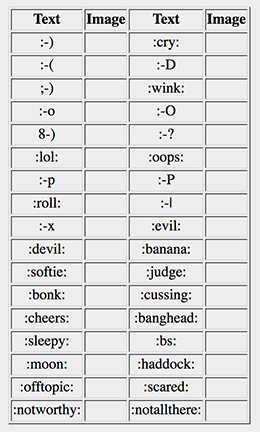
How do I use smilies in articles and news?
This site uses an integrated translator, for some modules, that will automatically translate certain codes into smilies. Below are the codes and what image they generate.

More Background On ArsFoodCourt.com
ArsFoodCourt.com was a specialized community website that emerged during the early years of volunteer distributed computing, serving as the home of the "Ars Technica Food Court," a collection of distributed computing teams formed by readers of Ars Technica. Active primarily between 2002 and 2005, the site documented one of the internet's most enthusiastic volunteer computing communities, providing news, statistics, team information, technical resources, tutorials, and community discussions centered on harnessing idle computer processing power for scientific research and cryptographic challenges.
Although the website itself is no longer actively maintained, archived versions reveal an important chapter in internet history when thousands of technology enthusiasts donated spare CPU cycles to solve problems that would otherwise have required expensive supercomputers. ArsFoodCourt.com functioned as both a technical resource and a social hub, bringing together members of the Ars Technica community around collaborative scientific and mathematical projects.
Unlike commercial technology websites that focused primarily on hardware reviews or software news, ArsFoodCourt.com celebrated cooperative computing. Visitors were encouraged not simply to read about technology but to participate directly in scientific discovery by contributing unused computing resources from their own desktop computers.
Relationship with Ars Technica
To understand ArsFoodCourt.com, it is first necessary to understand the remarkable growth of Ars Technica itself. Founded in 1998 by Ken Fisher and Jon Stokes, Ars Technica quickly became one of the internet's premier destinations for in-depth technology journalism. Rather than producing superficial product reviews, Ars became known for long-form technical analysis, processor architecture coverage, operating system reviews, networking discussions, and thoughtful reporting on science, computing, public policy, and digital culture.
The site's readership naturally consisted of technically sophisticated users who enjoyed building PCs, experimenting with operating systems, overclocking processors, running servers, and participating in online communities. This audience proved to be an ideal fit for the rapidly growing world of distributed computing.
As distributed computing projects became increasingly popular around the turn of the millennium, Ars Technica readers organized themselves into teams that competed with similar groups from other technology communities. Rather than treating these projects as isolated scientific endeavors, they transformed participation into a friendly competition complete with statistics, rankings, internal challenges, recruitment drives, and humorous team identities.
ArsFoodCourt.com became the centralized headquarters for these efforts.
The whimsical "Food Court" theme distinguished the Ars teams from competitors. Instead of generic names, each distributed computing project was assigned a food-inspired identity, creating a memorable branding system that reflected the playful culture of the Ars community.
The Origins of Distributed Computing
The concept behind distributed computing predates Ars Technica by many years. Researchers recognized that large computational problems could be divided into millions of smaller calculations, each of which could be solved independently before being recombined into a final result.
Rather than purchasing expensive supercomputers, organizations could distribute these smaller work units across thousands—or eventually millions—of ordinary personal computers connected through the internet.
Participants simply downloaded a lightweight client application that operated in the background whenever the computer was idle. The software requested work units from central servers, performed calculations using unused processor time, and returned completed results before requesting additional assignments.
This approach dramatically reduced computing costs while allowing scientific organizations to access enormous processing power contributed voluntarily by participants around the world.
By the early 2000s, distributed computing had expanded into numerous disciplines, including:
- astronomy
- cryptography
- genetics
- climate modeling
- cancer research
- protein folding
- mathematics
- particle physics
- pharmaceutical development
Ars Technica readers enthusiastically embraced nearly every major project available at the time.
Why the Food Court Was Created
As more Ars readers joined volunteer computing projects, numerous independent teams began forming across different scientific disciplines. Coordinating information about these teams through forum posts alone became increasingly difficult.
ArsFoodCourt.com addressed this challenge by consolidating everything into one organized portal.
The website provided:
- project descriptions
- team histories
- downloadable client software information
- rankings
- production statistics
- leaderboards
- tutorials
- FAQs
- news updates
- milestone celebrations
- recruitment information
Rather than replacing the official project websites, ArsFoodCourt.com acted as a community gateway that helped members understand each project before deciding where to contribute their computing resources.
The site also fostered a sense of identity. Members were not simply participating in Folding@Home or SETI@home; they were representing the Ars Technica community in worldwide competitions against teams from universities, corporations, hardware forums, and technology publications.
The Famous Food-Themed Teams
One of the most memorable aspects of ArsFoodCourt.com was its creative naming convention. Every distributed computing team adopted a food-related identity that fit within the broader "Food Court" concept.
Some of the best-known teams included:
Team Lamb Chop
Perhaps the most famous of all Food Court teams, Team Lamb Chop represented the SETI@Home project.
SETI@Home analyzed radio telescope data collected by the Berkeley SETI Research Center in search of possible extraterrestrial signals. Participants processed small portions of telescope observations using their home computers, helping scientists examine data far faster than would otherwise have been possible.
During its peak years, Team Lamb Chop became one of the highest-ranked SETI teams in the world. Archived records show the team reaching the number one global position while surpassing thousands of competing organizations.
Its remarkable production levels reflected both the size of the Ars Technica community and the technical enthusiasm of its members.
Team Egg Roll
Team Egg Roll supported Folding@Home, a groundbreaking project developed at Stanford University to study protein folding.
Protein folding is essential to understanding diseases such as Alzheimer's, Parkinson's, Huntington's disease, and many forms of cancer. By simulating how proteins naturally fold into three-dimensional structures, researchers hoped to better understand disease mechanisms and identify potential therapeutic targets.
Team Egg Roll consistently ranked among the world's leading Folding@Home teams and became one of Ars Technica's flagship distributed computing efforts.
Friendly rivalries with other technology communities—including HardOCP and AnandTech—helped drive participation and encouraged members to recruit additional volunteers.
Team Beef Roast
Team Beef Roast participated in distributed.net's RC5 cryptographic challenges.
Unlike scientific research projects, RC5 focused on testing encryption security through exhaustive key searches. Millions of computers collectively attempted every possible encryption key until the correct one was found.
Although cryptography may seem less humanitarian than medical research, these projects helped researchers evaluate encryption strength and understand the practical limits of brute-force attacks.
Team Beef Roast also participated in the distributed.net Optimal Golomb Ruler (OGR) mathematical challenges, demonstrating the diversity of computational interests within the Ars community.
Team Primordial Soup
Team Primordial Soup contributed to Genome@Home, another Stanford initiative closely related to Folding@Home.
Where Folding@Home examined protein structures, Genome@Home explored how genes encode proteins and how modified genetic sequences might produce proteins with desirable characteristics.
This research supported advances in molecular biology, pharmaceutical development, and bioinformatics.
The team frequently ranked near the top of worldwide standings, reflecting strong participation from Ars readers.
Team Crab Cake
Among the newest additions to the Food Court, Team Crab Cake focused on cancer research through the United Devices (later grid.org) platform.
Participants evaluated millions of molecular interactions in virtual drug-screening experiments, helping researchers identify compounds that might inhibit cancer-related proteins.
Although smaller than some of the established teams, Team Crab Cake illustrated how the Food Court continuously expanded to embrace new scientific opportunities as distributed computing evolved.
Community Competition and Team Spirit
One of the defining characteristics of ArsFoodCourt.com was that it transformed distributed computing from a solitary technical hobby into a collaborative community activity. Members rarely viewed themselves as simply running software in the background. Instead, they identified strongly with their Food Court teams and participated in friendly competitions that motivated increased participation.
The site regularly highlighted production milestones, welcomed new members, tracked team rankings, and celebrated significant achievements. Internal "gauntlets" encouraged participants to temporarily redirect their computing resources toward a specific project, allowing an Ars team to gain ground against rival organizations. These short-term competitions generated excitement within the forums and frequently resulted in dramatic increases in processing output.
Competition extended beyond the Ars community. Teams regularly measured themselves against groups representing universities, technology companies, hardware review sites, Linux communities, and other online forums. Moving up even a single place in the worldwide rankings could become a major community event, prompting recruitment drives and coordinated efforts to increase daily production.
This competitive spirit helped sustain long-term participation. Distributed computing projects often required months or even years to achieve meaningful scientific milestones, but the continual movement of team rankings gave volunteers a steady stream of goals and accomplishments along the way.
Technical Resources and Educational Content
ArsFoodCourt.com served as more than a scoreboard. It also functioned as an educational resource for newcomers interested in volunteer computing.
The site explained fundamental concepts such as work units, client software, benchmarking, CPU utilization, memory requirements, and project-specific terminology. A glossary introduced readers to abbreviations commonly used throughout the distributed computing community, including terms like DC (Distributed Computing), WU (Work Unit), DP (Distinguished Point), and "crunching," the colloquial term for processing computational tasks.
Many visitors were building their first custom computers during this era, making the tutorials particularly valuable. Guides covered topics such as:
- installing distributed computing clients
- optimizing processor performance
- configuring clients as Windows services
- operating "headless" computers without monitors
- running multiple projects
- monitoring production statistics
- joining Ars teams
- troubleshooting common client issues
The site also published news updates whenever major projects released new client software or introduced changes to their infrastructure. For example, announcements covered updates to Folding@Home clients, BOINC software, and project servers, ensuring that volunteers could maintain efficient participation.
Notable Projects Represented
Although Folding@Home and SETI@Home were among the most recognizable distributed computing efforts, ArsFoodCourt.com supported a remarkably diverse collection of scientific initiatives.
These included:
- SETI@Home, analyzing radio telescope signals for possible extraterrestrial intelligence.
- Folding@Home, studying protein folding to better understand diseases.
- Genome@Home, exploring gene and protein relationships.
- Distributed.net RC5, testing encryption through brute-force key searches.
- OGR (Optimal Golomb Ruler), solving advanced mathematical optimization problems.
- GIMPS (Great Internet Mersenne Prime Search), searching for new record-breaking prime numbers.
- Seventeen or Bust, another number theory project investigating prime numbers.
- ClimatePrediction.net, modeling long-term climate behavior.
- United Devices Cancer Research Project, screening molecular compounds for cancer treatments.
- Distributed Folding, improving computational protein-folding algorithms.
- ECC cryptographic challenges, investigating elliptic curve cryptography.
Each project appealed to different interests. Some participants preferred astronomy or mathematics, while others were motivated by medical research or climate science. ArsFoodCourt.com allowed volunteers to move between projects while remaining part of the broader Ars community.
News Coverage and Site Content
Archived versions of ArsFoodCourt.com show that it published a steady stream of news covering both distributed computing and broader technology topics.
Visitors could find articles discussing:
- NASA and space exploration
- computer hardware releases
- operating systems
- processor benchmarks
- scientific discoveries
- cryptography
- internet policy
- online privacy
- gaming
- software updates
- networking technologies
Many of these stories mirrored the editorial interests of Ars Technica itself while maintaining a focus on subjects relevant to technically inclined readers.
The site also highlighted important milestones achieved by distributed computing projects. Examples included announcements of newly discovered Mersenne prime numbers, advances in Folding@Home research, updates to Seventeen or Bust, improvements to distributed computing clients, and significant changes in project infrastructure.
These updates reinforced the idea that volunteers were contributing to real scientific progress rather than merely participating in a hobby.
Site Organization and Features
The website adopted a straightforward layout typical of early-2000s technology communities. Navigation emphasized functionality over visual design, making it easy for visitors to locate project information quickly.
Key features included:
- individual pages for every Food Court team
- project descriptions
- status indicators
- global rankings
- production statistics
- news archives
- FAQs
- technical documentation
- download information
- contributor acknowledgments
- revision histories
- links to project websites
- community terminology
Administrators also documented site revisions and acknowledged volunteers who contributed content or maintained project pages, reinforcing the collaborative nature of the community.
Unlike modern social media platforms driven by algorithms, ArsFoodCourt.com depended on volunteers to submit news, maintain documentation, and keep project information current.
Audience
The primary audience consisted of Ars Technica readers, but the site's appeal extended well beyond that core community.
Typical visitors included:
- PC enthusiasts
- Linux users
- software developers
- systems administrators
- engineers
- overclockers
- computer science students
- scientific computing enthusiasts
- hobbyists interested in distributed computing
- hardware reviewers
- networking professionals
Many participants maintained multiple computers dedicated almost entirely to distributed computing. Some even assembled inexpensive systems specifically for "crunching," maximizing scientific output while minimizing costs.
This culture foreshadowed today's enthusiasm for home labs, Raspberry Pi clusters, and enthusiast computing projects.
Popularity and Community Impact
Although ArsFoodCourt.com never approached the mainstream visibility of Ars Technica itself, it became highly respected within the distributed computing world.
Several Ars teams reached or maintained first-place worldwide rankings in their respective projects, demonstrating the extraordinary participation levels of the community. Team Lamb Chop, Team Egg Roll, Team Prime Rib, and others frequently appeared near the top of international leaderboards.
The site's influence was amplified by Ars Technica's already substantial readership. Thousands of technically knowledgeable users could be recruited into new projects through articles, forum discussions, and Food Court announcements.
In an era before social media, this represented an exceptionally effective method of organizing large volunteer computing efforts.
Cultural and Historical Significance
ArsFoodCourt.com represents an important snapshot of internet culture during the early broadband era.
The early 2000s witnessed remarkable optimism regarding collaborative online projects. Wikipedia was growing rapidly, open-source software communities were flourishing, and distributed computing demonstrated that ordinary individuals could collectively contribute enormous computational resources to scientific research.
The Food Court embodied this philosophy.
Rather than monetizing user attention or harvesting personal data, the site encouraged participants to donate spare computing capacity for public benefit. Members celebrated discoveries in mathematics, advances in medicine, and improvements in scientific understanding.
This cooperative spirit anticipated later developments such as citizen science initiatives, cloud computing, crowdsourcing, and volunteer data analysis projects.
Many concepts that seem commonplace today—distributed infrastructure, decentralized computation, and collaborative online problem-solving—were demonstrated successfully by communities like the Ars Food Court years before commercial cloud platforms became dominant.
Legacy
Although many of the original distributed computing projects have concluded or evolved into newer initiatives, the legacy of ArsFoodCourt.com remains significant.
Modern distributed computing projects continue to benefit from lessons learned during this pioneering era. Projects such as Folding@Home have expanded dramatically, attracting millions of volunteers during global health emergencies such as the COVID-19 pandemic. The underlying principle remains unchanged: ordinary computers working together can accomplish extraordinary scientific tasks.
ArsFoodCourt.com also illustrates how strong online communities can organize around shared intellectual interests rather than purely social interaction. Its combination of technical education, friendly competition, volunteerism, and scientific contribution created an environment that inspired thousands of participants to support research simply by leaving their computers running.
For historians of the internet, the website offers a fascinating record of early online collaboration. For former participants, it evokes memories of late-night benchmarking sessions, carefully tuned overclocked processors, and the satisfaction of watching a favorite team climb the worldwide rankings one work unit at a time.
Ultimately, ArsFoodCourt.com was far more than a collection of statistics pages. It was a community-driven project that captured the optimism of an era when technology enthusiasts believed their collective computing power could help solve some of science's most challenging problems—and, in many cases, they did.